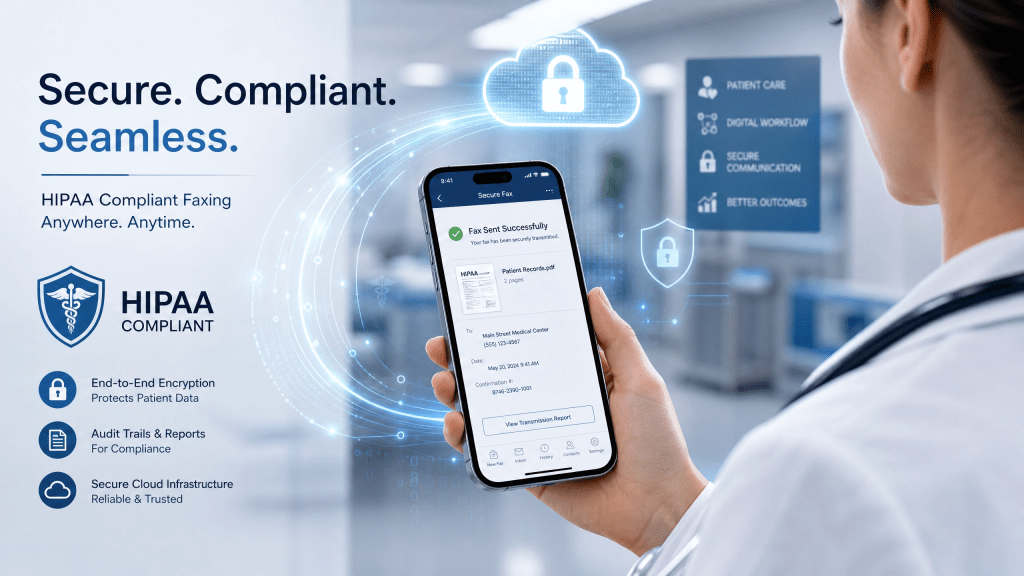
The American healthcare landscape in 2026 is a marvel of modern technology. Surgeons utilize AI-assisted robotics, clinics leverage real-time cloud analytics for patient care, and prescription updates flash across mobile screens instantaneously. Yet, walk into any busy hospital department, private practice, or community clinic across the United States, and you will undoubtedly hear a sound that feels entirely stuck in the past: the rhythmic screech and hum of a traditional fax machine.
To outsiders, the persistence of faxing in modern medicine seems like an absurd administrative stubbornness. But to medical professionals, nurses, administrative staff, and clinic managers, the reason is perfectly clear. It boils down to a single, unyielding, and legally binding acronym: HIPAA (Health Insurance Portability and Accountability Act).
Under US federal regulations, Patient Health Information (PHI) cannot simply be zipped over a standard email attachment or texted through a traditional messenger. The security risks of data interception, unencrypted servers, and unverified recipients are too severe, potentially resulting in catastrophic federal fines and breached patient trust. Because traditional faxing operates over the Public Switched Telephone Network (PSTN), it has legally held its ground as a highly secure, point-to-point communication channel.
However, holding onto physical fax machines in 2026 comes with its own nightmare of logistics. Thermal paper jams right when an urgent prior-authorization is needed, ink cartridges run out mid-transmission, and administrative staff waste hours standing in corridors waiting for confirmation sheets. Medical workers need a modern solution—they need a smartphone-based hipaa compliant fax app that bridges the gap between old-school regulatory compliance and 21st-century mobile efficiency.
The Reality Filter: The Search for Reliability in Healthcare Utilities
The major hurdle for medical workers isn’t a lack of options; it’s a lack of verifiable quality. If you open the iOS App Store today and type in “fax app,” you will be bombarded with hundreds of sleek, colorful applications boasting bold claims. Many feature bright marketing badges proclaiming themselves to be the ultimate healthcare assistant.
Unfortunately, the medical field leaves zero room for trial and error. Some apps look good, but once you use them, you realize they’re not that reliable. In a fast-paced clinical setting, a subpar application reveals its flaws instantly. It might drop the connection when trying to transmit a complex, 15-page patient history file. It might lack an automatic text-sharpening algorithm, leaving fine-print lab results completely unreadable on the recipient’s end. Or worst of all, it might hide its technical “compliance” behind an incredibly deceptive paywall, failing to provide the encryption standards required by law when you actually hit send.
When a patient’s continuity of care or an urgent specialist referral hangs in the balance, a dropped transmission or an unverified delivery is an administrative failure you cannot afford. Healthcare professionals require an architecture that prioritizes end-to-end security, document clarity, and absolute data integrity from the moment a file is captured to the moment it triggers a successful handshake on the receiving machine.
Technical Benchmarks: What Defines a True HIPAA Compliant Fax App?
To confidently transition from a heavy desktop machine to a pocket-sized mobile utility, medical workers must ensure that the software aligns perfectly with the standards enforced by the US Department of Health and Human Services (HHS). A simple tool designed for sending a casual cover letter won’t suffice. A professional-grade healthcare app must establish a specific ecosystem of safeguards:
1. Advanced End-to-End Encryption
Data must remain completely secure in transit and at rest. A compliant application utilizes banking-grade encryption protocols (such as AES-256 bit encryption) to wrap the document in an unreadable digital vault while it travels across digital networks.
2. Strict Biometric and Local Security
Nurses and doctors are constantly on the move, frequently setting their phones down on nurse stations or triage desks. A secure app must feature localized biometric lockouts, such as FaceID or TouchID authentication. If the phone is left unattended, unauthorized individuals should never be able to access the application’s outbound history or review past medical records. Furthermore, scanned medical documents must never cache directly into the phone’s default, unencrypted personal photo library.
3. Definite Transmission Verification Reports
In healthcare administration, documentation is everything. If an insurance provider claims they never received a critical prior-authorization form, an unverified “Sent” status inside an app won’t protect you. A professional application must generate a formal, legally binding Transmission Verification Report. This downloadable document records the exact time, date, recipient number, and page count, serving as your absolute compliance shield.
While managing these high-security clinical environments is critical for daily workflows, medical professionals are humans too. They often find themselves needing to manage lightweight, personal administrative tasks outside of the office—such as sending a quick document to a landlord or handling personal banking paperwork. For those everyday, non-clinical tasks that don’t involve sensitive patient records, it is incredibly helpful to keep a secondary, simple fax app for personal daily usage on your device to keep your professional and personal documentation completely separate.
Optimizing the Mobile Workflow: From Physical Paper to Instant Digital Delivery
In a clinical setting, paperwork rarely starts as a clean digital file. More often, you are dealing with a physical, crumpled piece of paper—a handwritten doctor’s note, an external lab report, a patient intake sheet, or a signed physical consent form.
To turn this physical paperwork into a legally compliant digital format, the mobile app must act as an advanced document scanner. Using an outdated mobile camera tool often results in gray backgrounds, heavy shadows, and skewed angles that make numbers illegible once compressed through a fax line.
Modern, dedicated healthcare applications utilize specialized machine-learning algorithms to rectify these issues instantly. When a medical worker holds their phone over a document, the software automatically detects the page boundaries, flattens perspective distortions, removes overhead shadows caused by harsh hospital lighting, and increases the text contrast. The resulting output looks like a pristine, high-resolution PDF generated by a heavy-duty office flatbed scanner.
Once the document is digitized, the workflow becomes completely streamlined:
- Select a Template: Apply a professional cover sheet detailing the sender, recipient, and a standardized HIPAA confidentiality notice.
- Input the Number: Enter the destination US fax number (with pre-configured shortcuts for frequently contacted pharmacies, clinics, and insurance payers).
- Track in Real-Time: Watch the active outbound queue change from “Dialing” to “Transmitting” to “Completed.”
- Archive the Receipt: Export the confirmation log directly into your clinic’s electronic health record (EHR) system for perfect bookkeeping.
The Definitive Mobile Tool for US Healthcare Workers
If you are ready to eliminate the administrative logjam of physical machinery and protect your workflow with a secure, highly dependable utility, look no further than the Fax App on iOS.
Engineered specifically to handle the rigid demands, high volumes, and security mandates of modern professional documentation, this application effectively turns your iPhone or iPad into a secure, mobile administration center. It eliminates the clunkiness of old-school tech while keeping your administrative standards fully aligned with federal privacy regulations.
Medical practitioners, administrative assistants, and telehealth providers can download the software directly on the iOS App Store via this official App Store Download Link. Implement it into your daily rotation to discover how seamless, secure, and stress-free modern digital documentation can truly be.
 Faxapp - Best Online Fax Service | Send Faxes Online Securely
Leave a comment